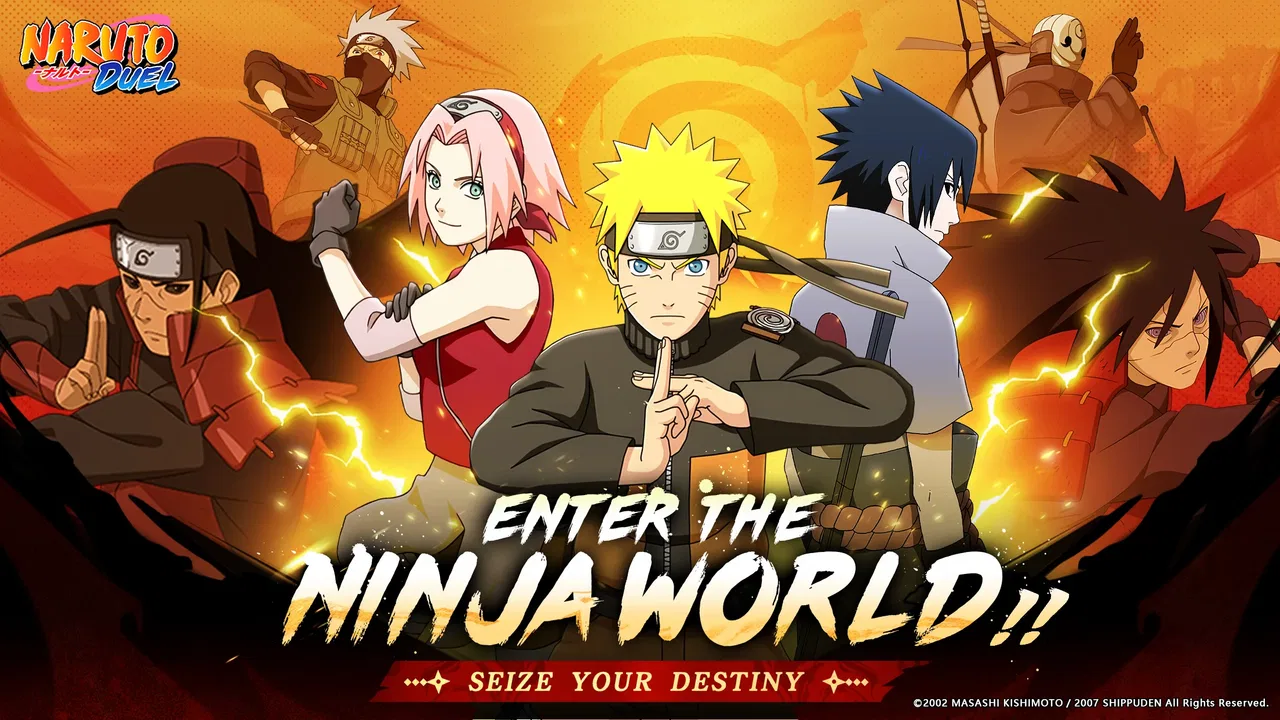
Naruto: Duel
- 3.5
- Rating
- 50.00K
- Installs
- Free
- Price

 Analysis by App-foxy
Playing Naruto: Duel feels like stepping into a compact role-playing game built around Naruto’s world, but the most important question is not simply whether the characters are familiar. It is whether the duel-focused structure gives you enough meaningful decisions to justify returning every day. I approached it with that in mind: how quickly the game becomes understandable, how much pressure it places on progress, and whether spending changes the experience in ways that matter.
The game is free to download, carries a Teen content rating, and comes from Paramount Int'L Co., Limited. It is positioned as an official Naruto title rather than an unrelated anime-inspired imitation, which immediately gives it a stronger reason to exist for fans who want recognizable material on a phone. At the same time, the Naruto name can raise expectations that the underlying game has to earn. A familiar cast is a good starting point, but it cannot replace satisfying battles or fair advancement.
How Naruto: Duel feels to play and where the real trade-offs appear
I’d judge the game’s speed by how smoothly its duel-and-progression rhythm fits into a short visit, rather than expecting a reflex-heavy fighter. The useful question is whether I can make a few considered choices and leave with a clearer sense of what to try next. From there, the bigger test is how that pace holds up when I return often and push through tougher moments.
You May Also Like

 AccuWeather: Weather Radar
AccuWeather Review: A Quick, Clear Forecast for Everyday Decisions
For everyday plans, the best forecast is the one you can understand quickly. AccuWeather makes rain timing, radar, and local conditions easy to act on, with a few trade-offs.

 Hill Climb Racing
Why Hill Climb Racing Still Turns Crashes Into One More Run
A tiny car, a bumpy hill and one more upgrade: Hill Climb Racing keeps resurfacing because its simple chaos makes every near-miss feel personal.

 AliExpress - Shopping App
AliExpress Makes Global Shopping Feel Personal, but Shoppers Bear the Risk
AliExpress turns a global marketplace into a pocket-sized discovery engine. Its reach is useful, its shopping loop compelling, and its trade-offs easy to miss.

 Lords Mobile: Kingdom Wars
Lords Mobile Is a Kingdom-Building Routine, Not a Quick Match
A case-by-case verdict on the building, battles, device demands, and social commitments that make Lords Mobile rewarding for some players and exhausting for others.

 PDF Scanner app - TapScanner
TapScanner Makes Paperwork Easier to Capture, Check, and Share
TapScanner makes scanning with a phone feel less like a rescue operation and more like a dependable step in getting work done. Its capture tools are useful, though not flawless.

 Block Blast!
 Shows How Much a Puzzle Game Can Leave Out
A quiet grid game shows why puzzle players increasingly value instant clarity, repeatable skill and low-pressure play—and where the genre still needs to catch up.
More From Our News Desk
View All News


A focused role-playing format for short sessions
The clearest appeal is the combination of character progression and strategic duels. This is not presented as a broad open-world adventure where I wander freely through a large version of the Hidden Leaf. Its identity is much narrower: build toward stronger encounters, make tactical choices, and use Naruto-themed abilities in battles that are meant to feel decisive.
That focus makes the game easier to fit into a normal day. I can imagine opening it during a commute, between errands, or after work when I want something more involved than a quick arcade round but do not have the energy for a long console session. The role-playing layer gives those short visits a sense of continuity, while the duel format keeps the central activity from becoming completely shapeless.
The best way to approach it is to treat each fight as a small planning problem rather than tapping through every available action. When a game advertises ultimate techniques and strategic duels, the useful question is not how spectacular an ability looks, but what it costs me to use it now instead of saving it for a later exchange. I found that mindset more rewarding than chasing flashy moves for their own sake.
That also makes the game more suitable for Naruto fans who enjoy the tactical side of the franchise. Someone looking mainly for a fast action fighter may find the role-playing structure less immediate. The appeal is in preparing, choosing, and improving, not only in reacting quickly.
What the Naruto setting adds beyond recognition
The license gives every decision extra emotional context. A duel involving a familiar ninja feels different from a battle between anonymous fantasy units, because I already understand the personality and history attached to the character. Even when the underlying mechanics are conventional, the Naruto presentation can make progression feel more personal.
Still, I would not recommend installing it solely because the title says Naruto. Licensed games can be enjoyable for fans while remaining limited as games, and this one needs to be judged by how well its role-playing loop holds together. If you want a deep story campaign with extensive exploration, this is probably not the first place I would look. If you want a mobile game that turns the franchise into repeated tactical confrontations, the fit is much clearer.
The store summary emphasizes unleashing powerful jutsu and mastering strategic duels. In practice, that promise should be read as an invitation to think about timing and matchup decisions, not as a guarantee that every battle will be complex. The experience is most convincing when the familiar theme supports actual choices instead of merely decorating a sequence of upgrades.
Progression is motivating, but it can also create pressure
Role-playing games live or die by the feeling that improvement comes from understanding the game, not just waiting for a bigger number. I paid attention to that distinction while considering how Naruto: Duel might fit into a regular routine. A healthy progression loop should make a player feel that a difficult duel became manageable because of better preparation, smarter ability use, or a more suitable team approach.
The potential friction is familiar to this category. Free mobile role-playing games often ask players to balance patience with ambition. If advancement slows at the exact point where the next battle becomes attractive, the game can shift from a strategic hobby into a test of how long I am willing to tolerate repetition. That does not automatically make the design unfair, but it changes the kind of player who will enjoy it.
My practical advice is to decide early what kind of player you are. If you are happy to progress gradually and use each session to improve your understanding, the free entry point is valuable. If you expect to unlock everything quickly or compete immediately with highly developed accounts, the pressure will be more noticeable. The game is better suited to steady play than to a rushed attempt to reach the top.
A useful habit is to avoid spending simply because one duel went badly. First work out whether the problem was a poor tactical choice, an underdeveloped character, or a genuine progression wall. Those are different problems, and only one of them might be addressed by purchasing something. This is one of the most important distinctions for any free role-playing game: do not confuse frustration with a clear reason to pay.
Spending deserves a careful, limited reading
The game includes optional in-app purchases ranging from $0.49 to $99.99 per item. That is a wide span, and it tells me that the free download is connected to a monetization system designed for both small and substantial transactions. It does not, by itself, prove that paying is required, nor does it prove that every purchase offers good value.
For a new player, the safest approach is to play long enough to understand the progression rhythm before buying anything. A low-cost item may be an inexpensive convenience, while a high-priced item represents a much more serious commitment. Without knowing exactly how each purchase affects a particular account, I would not treat the most expensive option as a sensible shortcut by default.
I also recommend setting a personal limit before beginning. That sounds obvious, but role-playing games can make a purchase feel urgent when a character, duel, or reward is placed directly in front of you. A budget decided in advance protects the fun part of the game from turning into an impulsive contest with the interface.
Players who want a completely predictable cost should be aware that this is not that kind of product. The download is free, but the presence of purchases means the full experience is not defined by one fixed payment. For me, that makes the game easier to recommend as a trial than as a guaranteed long-term value proposition.
Fairness depends on what competition asks from the player
The word “duel” naturally raises a fairness question. In a role-playing game, competitive balance can be affected by progression, character strength, access to resources, and spending. I would be cautious about assuming that skill alone determines every result. The purchase range confirms that money can be spent inside the game, but it does not establish exactly how strongly those purchases influence competitive outcomes.
That uncertainty matters. If you mainly enjoy testing your decisions against other players, you will want to observe whether victories feel connected to tactical choices or to account development. Pay attention to the pattern rather than one isolated loss. A single defeat can come from a mistake; repeated encounters where the opponent’s power overwhelms every reasonable decision suggest a different kind of balance.
My recommendation is to enter competitive modes with modest expectations until you understand the environment. Do not spend to chase a ranking position before you know whether the rewards justify the effort and whether the game’s progression model suits you. For casual duels, the title may still be enjoyable even if it is not the ideal choice for someone seeking a tightly controlled esports-style contest.
This is where Naruto: Duel differs from a traditional premium fighting game. A premium fighter usually asks for a clearer upfront commitment and then emphasizes direct mechanical mastery. This game offers a free starting point and a role-playing layer, but that convenience comes with more questions about progression and purchases. Neither model is automatically better; they serve different expectations.
How it compares with other Naruto and role-playing choices
Compared with a conventional action game, this title should appeal more to players who enjoy preparation and gradual character development than to players who want every match to be decided by reflexes. Compared with a purely story-driven Naruto experience, it places more weight on repeatable duels and account growth. That makes it a better fit for routine play than for a single, tightly authored adventure.
It also occupies a middle ground between casual mobile entertainment and more demanding competitive games. The Naruto identity makes it approachable, while the role-playing structure gives it more persistence than a one-minute time filler. The trade-off is that persistence can become maintenance if the daily loop stops feeling purposeful.
If you want to play for free, sample the franchise, and decide gradually whether the duel system deserves your time, this is a reasonable format. If you dislike upgrade-driven games, dislike optional purchases on principle, or want a one-time purchase with a clearly bounded experience, I would choose a different category altogether. The game’s strengths are tied to the same systems that may frustrate those players.
Questions I would answer before installing
Is it suitable for a newer phone? The minimum operating system is Android 7.0, so the stated software requirement is relatively broad. That helps people using older Android devices, although the actual comfort of play can still depend on the phone’s hardware and how demanding the battles become. I would keep reasonable free storage available and close unnecessary apps if performance feels inconsistent.
Is it appropriate for children? The Teen rating means I would not treat it as a child-focused game. Parents should consider the rating alongside the in-app purchase system, especially if a shared device can make purchases without careful supervision. Naruto familiarity does not automatically make every part of a licensed game suitable for younger players.
Can someone enjoy it without paying? The game is free to download, so trying it without an initial purchase is straightforward. Whether a player remains comfortable without spending depends on patience, the pace of progression, and how important competitive success becomes. I would begin as a free player and only reconsider after learning the loop rather than assuming payment is necessary from the first session.
Does the rating guarantee a polished experience? No. An average rating of 3.5 from around 328 ratings gives potential players a mixed signal rather than a decisive endorsement. I would read that as a reason to test the game personally, not as proof that it is poor. The relatively modest audience also means I would avoid drawing sweeping conclusions from the score alone.
Who should skip it? I would skip it if my main goal were a premium Naruto adventure, a fully transparent competitive ruleset, or a game with no spending prompts. I would also be cautious if I tend to make purchases when progress feels slow. The free entry point is attractive, but self-control matters more here than the download price suggests.
What I would do during a normal week
On a weekday, I would use short sessions to learn the rhythm of the duels rather than trying to force a long grind. I would review what caused a loss, adjust my approach, and stop when the game began to feel like repetition instead of decision-making. That keeps the role-playing layer useful: each return has a purpose, even if the purpose is simply understanding one more matchup.
On a quieter evening, I would be more willing to test a different approach and see whether a difficult encounter could be solved without immediately looking for a purchase. This is a good way to separate the game’s strategic depth from its progression pressure. If changing my decisions produces better results, the duel system is doing meaningful work. If only increased power changes the outcome, my enthusiasm would drop.
I would also keep spending separate from performance evaluation. A purchase can make progress faster, but faster progress is not the same as a better game. The real test is whether I enjoy the battles after the novelty of the license fades. That is the point at which Naruto: Duel either becomes a regular companion or returns to the uninstall list.
My trust verdict for Naruto: Duel
Naruto: Duel is worth trying for Naruto fans who like mobile role-playing games built around strategic confrontations and gradual progress. Its free starting point lowers the risk of experimenting, while the official setting gives the battles more personality than an original game with generic characters. I especially see its value for players who enjoy checking in regularly, learning from losses, and treating powerful jutsu as tactical tools rather than automatic win buttons.
My recommendation is more cautious for competitive players and anyone sensitive to monetization. The game includes purchases from $0.49 to $99.99 per item, and the available facts do not establish exactly how much those purchases affect competitive balance. That means I would not promise a purely skill-based contest or encourage anyone to spend before understanding the progression system.
The title was released on Jan 5, 2026, and its current version is 15, so it is presented as a relatively new entry with an active version number rather than a long-established mobile classic. I would give it a fair trial, keep the first sessions free, and judge it by the quality of its decisions once the Naruto novelty settles. For me, that makes it a qualified recommendation: appealing as a free experiment, potentially rewarding for patient fans, but not a purchase-free guarantee of competitive fairness.
If you want a Naruto-themed game that can fill short breaks with character growth and tactical duels, install it with realistic expectations. If you want a fixed-price experience or complete certainty that spending will never matter, choose another option. The most trustworthy way to approach this one is simple: enjoy the franchise, watch how progress feels, and let the battles—not the pressure to buy—decide whether it deserves a permanent place on your phone.
FAQs for Naruto: Duel
01What is the main objective of Naruto: Duel?
Naruto: Duel is a strategy-based card game where players collect and upgrade cards featuring characters from the Naruto universe. The main objective is to build the strongest deck to defeat opponents in real-time battles. Players can engage in solo campaigns or compete against others in multiplayer modes, showcasing their strategic skills and card combinations.
02Is Naruto: Duel free to play, and are there any in-app purchases?
Naruto: Duel is free to download and play, but it offers in-app purchases. Players can buy card packs, cosmetic items, and other enhancements to improve their gaming experience. While purchases can enhance gameplay, they are not essential to progress, allowing players to enjoy the game without spending money.
03What devices are compatible with Naruto: Duel?
Naruto: Duel is available on both Android and iOS platforms. For Android devices, it requires version 5.0 or higher, and for iOS devices, it needs iOS 10.0 or later. The game is optimized for smartphones and tablets, providing a seamless experience regardless of the device used.
04How does multiplayer mode work in Naruto: Duel?
In Naruto: Duel, the multiplayer mode allows players to challenge others worldwide in real-time battles. Players are matched based on their skill level and deck strength, ensuring fair competition. Winning battles earns rewards and improves rankings, adding a competitive edge to the gameplay experience.
05Are there any social features in Naruto: Duel?
Yes, Naruto: Duel includes various social features to enhance player interaction. Players can join clans to collaborate with others, share strategies, and participate in clan battles. The game also features a chat system, allowing players to communicate and form friendships within the Naruto community.
Pros
- Engaging combat mechanics enhance gameplay.
- Stunning graphics capture the anime's style.
- Diverse character roster with unique abilities.
- Regular updates with new events and content.
- Smooth performance on most devices.
Cons
- In-app purchases can be pricey.
- Requires constant internet connection.
- Some characters feel overpowered.
- Occasional server connectivity issues.
- Long loading times during peak hours.

Naruto: Duel
Gallery